A hospice nurse has revealed the signs she frequently observes in the last 24 hours of a patient’s life, noting that they are not as frightening as many might believe.
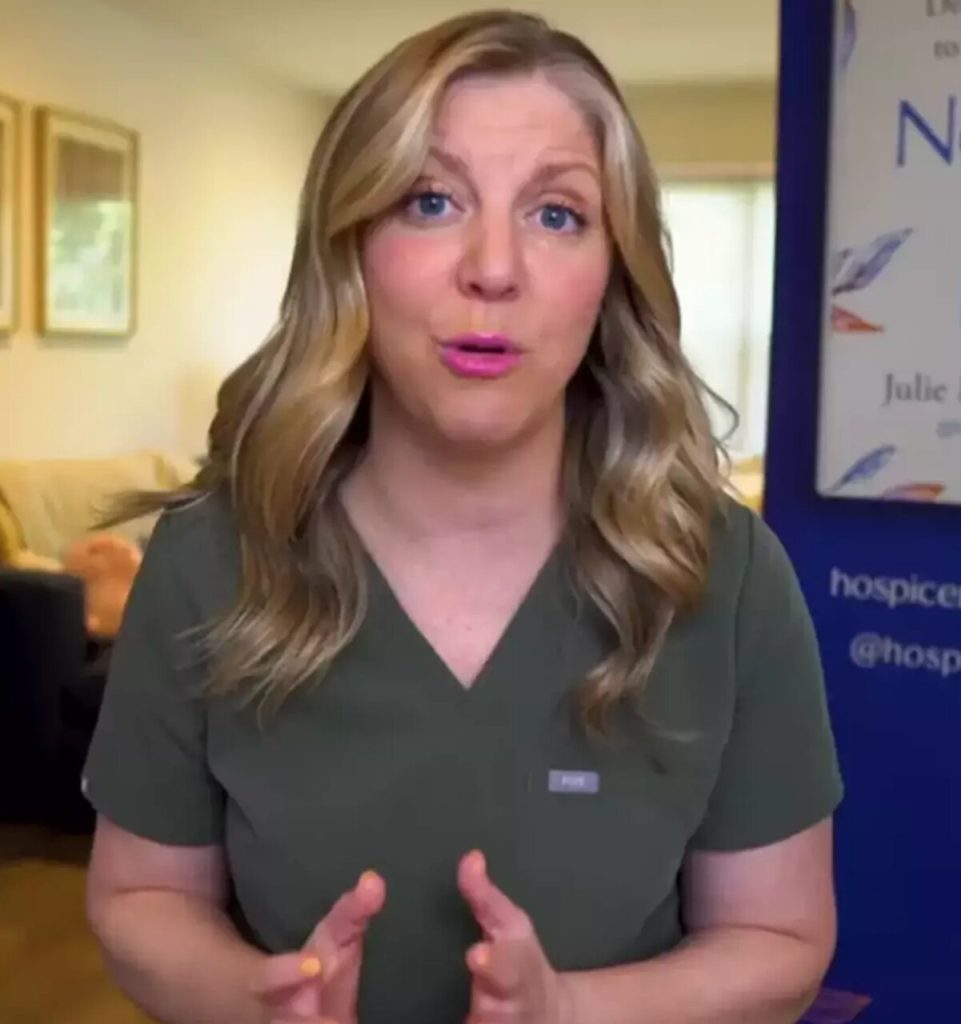
Julie McFadden, a palliative care nurse from California who is known online as Nurse Julie, has dedicated 16 years to end-of-life care. She has amassed 1.7 million followers on TikTok by sharing her insights and working to dispel the stigma and fear surrounding death.
Julie has also authored a book titled Nothing to Fear: Demystifying Death to Live More Fully, which explains what truly occurs in our final moments.
During her appearance on the Dr Karan Explores podcast, she mentioned that some individuals seem to possess an unexpected degree of control over the timing of their passing. “They often say, ‘I’m going to die after this date’ or ‘I’ll wait for my daughter’s wedding,’” she explained.
“I’ve actually had a patient declare, ‘I’m dying tonight’ and then pass away, even though they weren’t in the process of dying at that moment.”


Now, Julie has disclosed the three most prevalent signs she observes when death is merely a day away.
- The ‘death rattle’
The first sign, which can be particularly distressing for families, is known as the “death rattle.” This occurs when the patient loses the ability to swallow or cough, leading to the accumulation of saliva and mucus in the throat and airways.
As air passes through this fluid, it produces a rattling or gurgling sound. Julie notes that this typically happens within 24 hours of death, and despite the unsettling noise, it is not painful. “It’s simply a part of the body’s natural shutdown process,” she explains.
- Changes in breathing
The second indicator is a shift in breathing patterns. Breaths may become slower, more erratic, or spaced out significantly. Some patients may take extended pauses between breaths, which can create the impression that they have stopped breathing altogether.
In their final hours, many individuals exhibit what is known as “agonal breathing”; these are short, gasping breaths that can be quite alarming. Julie reassures families that this is a normal reflex when the brain is deprived of oxygen, and it does not cause the patient any distress.
- The ‘death stare’
Lastly, Julie describes a phenomenon she refers to as the “death stare.” The patient may have their eyes and mouth open but remain completely unresponsive. Their gaze appears fixed and unfocused, as if “no one’s really home.”
Although this can be a confronting sight, Julie emphasizes that it is often a tranquil moment, and hearing is typically the last sense to fade, allowing loved ones’ voices to still provide comfort.
She emphasizes that while these signs are common, they are not experienced by everyone. “Some individuals pass away suddenly, while others may take longer,” she states. “However, understanding what to expect can help alleviate fear for everyone involved.”
